by John Sparks
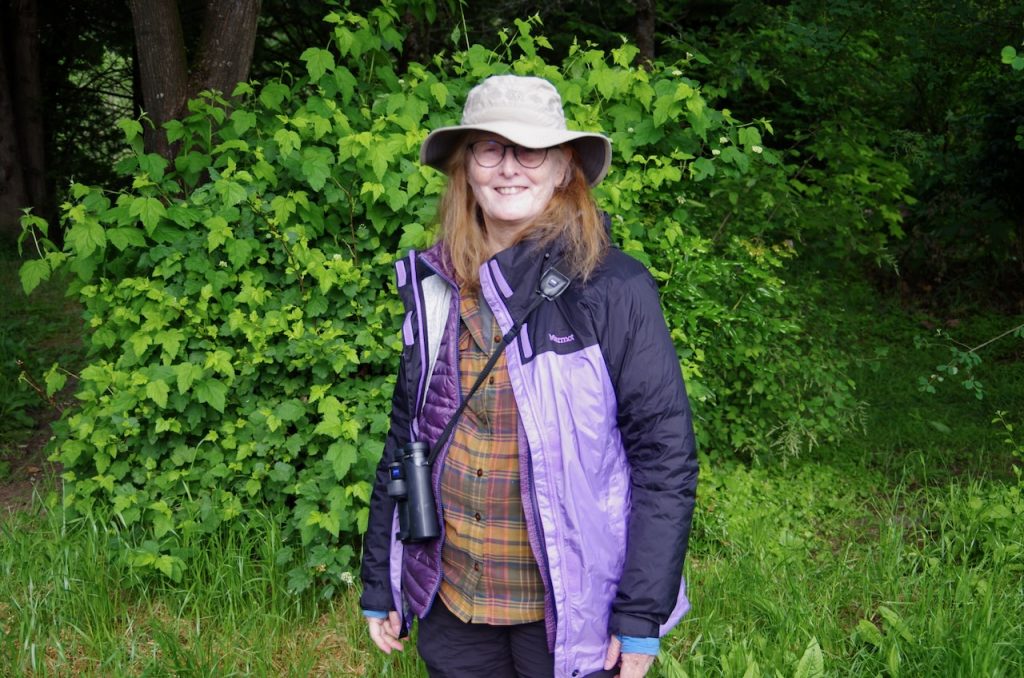
Forty years ago, Sarah Sloane was scratching around for a dissertation topic that would take her to to the Chiricahua Mountains (southeast Arizona), where her husband had already decided to work on his dissertation on forest ecology. A comparative study of three species of wren was the initial idea, but she decided that wrens were not that compelling. However, bushtits were fascinating, in a variety of ways, and in 1986 Dr. Sloane began her lifelong investigation of the bushtits’ private lives, focusing on their cooperative breeding behavior.
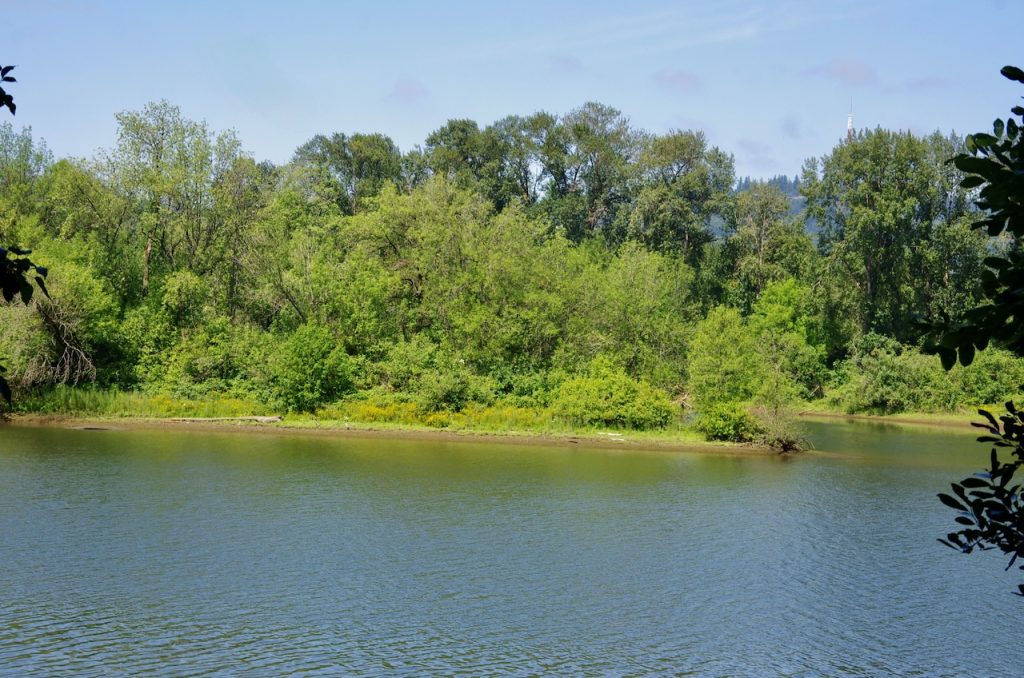
As a professor teaching behavioral ecology at the University of Maine at Farmington, Dr. Sloane continued to devote some months every year to studying bushtits in Arizona. Some harsh drought seasons severely depleted the populations there and, with a daughter attending Reed College in Portland, she turned her attention to the Pacific Northwest. For the last 11 years, she has been coming to Oaks Bottom and other locations in Portland to observe, band, and take DNA samples from the local bushtit population. Her study focuses on the nesting season, usually March through June. A small group of local volunteers and students from Maine assist in this longitudinal study, and a body of work based on Dr. Sloane’s unique expertise has slowly developed.
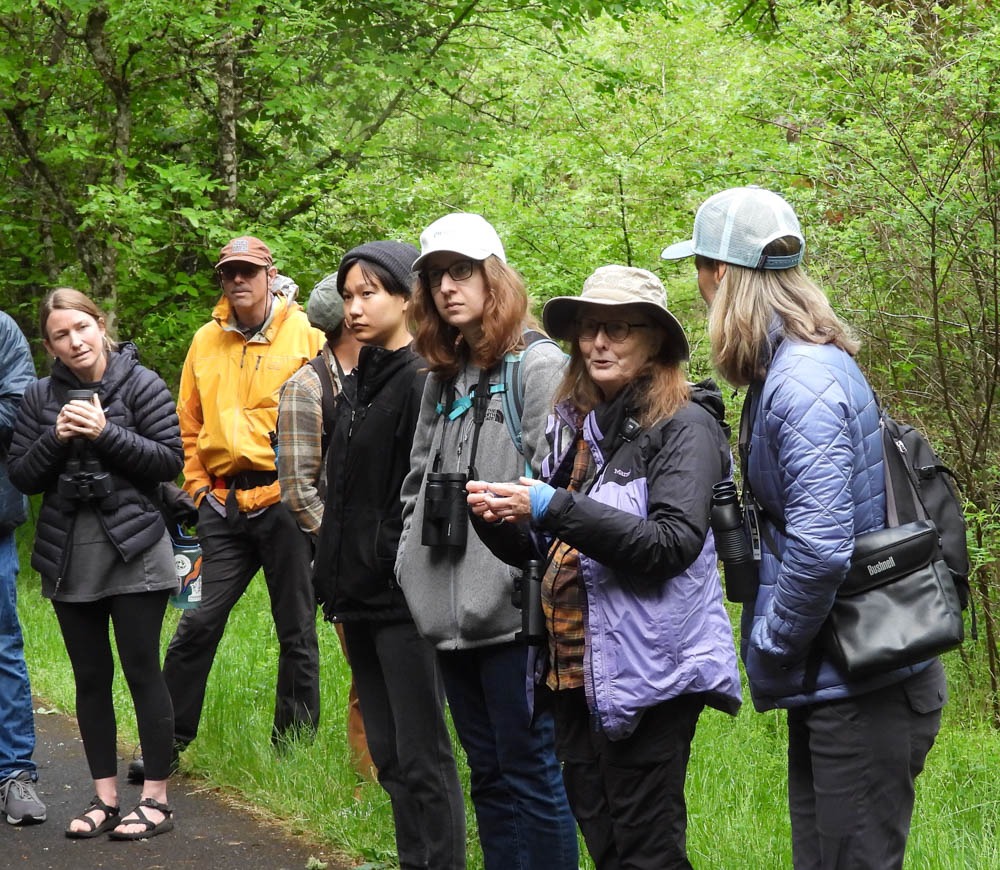
Friends of Oaks Bottom invited Dr. Sloane to lead one of our nature walks on the 16th of May this year, and it is safe to say that participants were fascinated by the range and depth of knowledge she shared about these small, rather drab birds. Sarah pointed out that this year is a “banner year” for bushtits, perhaps because of low mortality during the mild 2025-26 winter.
Sarah pointed out several bushtit nests, most of them with chicks ensconced. The first nest was #43, so designated because it was the 43rd nest to be catalogued at Oaks Bottom this season. We were able to see adults flitting back and forth with insect morsels for their charges. One nest had been plundered by a predator and had been abandoned. Near another, a pair of bushtits was hazing a squirrel. Once it moved off, they continued feeding their chicks. One of the most important findings of this study is that adults other than the parents assist in nest building and feeding, so-called cooperative breeding behavior.
So how does Sarah’s team gather data about bushtits? Simply spending time observing is the most basic strategy. Mist nets, which do no harm to the birds, are used to catch adults for banding. The team also takes DNA samples from nestlings. The researchers cut a slit in the side of the nest and remove half of the chicks. They will take the chicks about 15-20 yards from the nest to get DNA samples. This does not seem to disturb the parents, who will continue to come and go from the nest. The team puts the chicks back into the nest and removes the others to complete the DNA sampling. The samples are then sent to a lab for analysis.
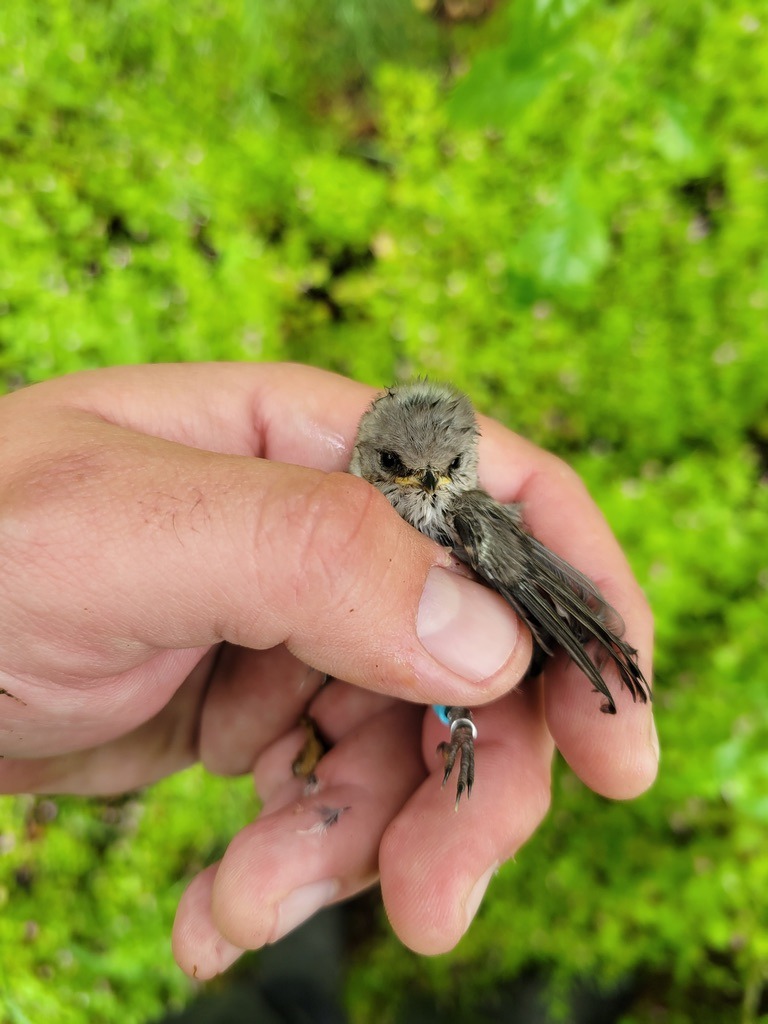
Photo: Amit Gordan
Fun facts about bushtits:
The bushtit is the smallest bird in North America that is not a hummingbird. The average weight is 5 ½ grams, half the size of a chickadee. Their tail is half of their length.
Bushtits are not true tits, but belong to the family Aegithalidae (the long-tailed tits), which has 11 species (or 13, according to some authorities). All the other long-tailed tit species are found in Eurasia.
Bushtits don’t practice seasonal migration, but they can move to warmer areas nearby in winter. They can be found in western North America from southern British Columbia to Guatemala.
It is difficult to distinguish male and female bushtits in the field, but females have yellow eyes while males have dark eyes.
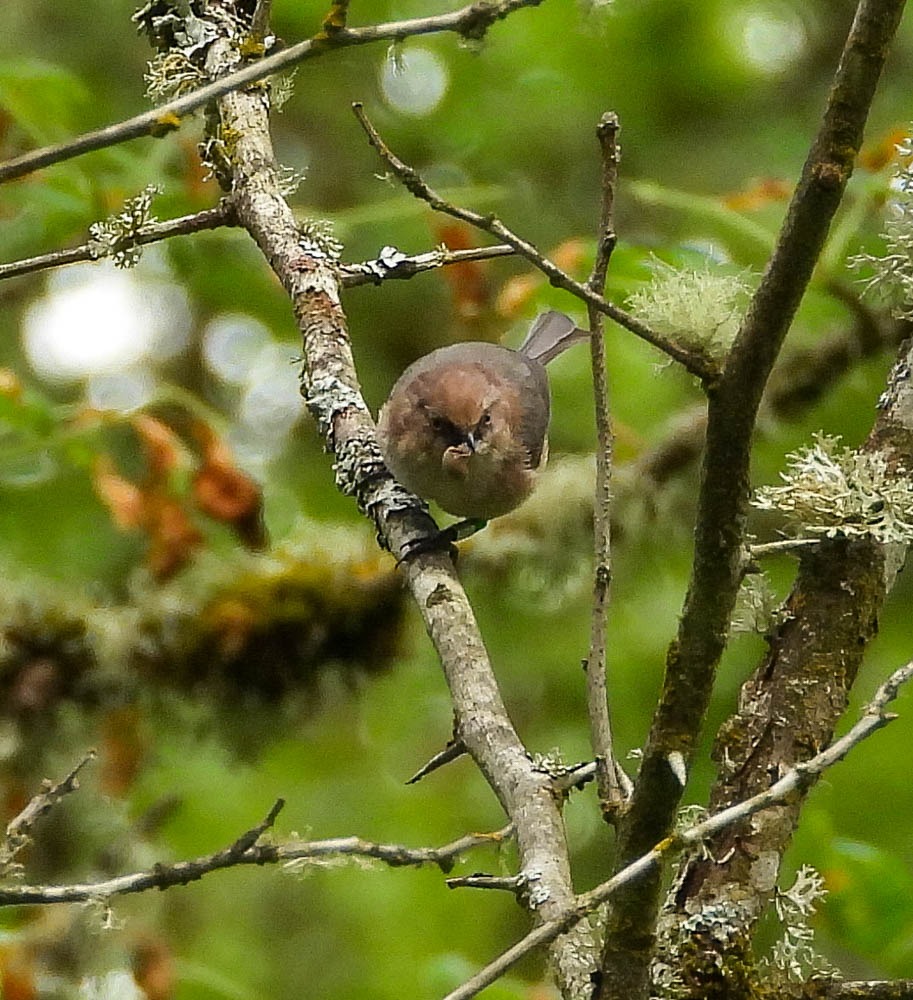
American bushtits generally form flocks of ten to 45 birds, sometimes including other small passerines such as goldfinches and kinglets. In summer, these flocks may increase to 100 birds.
They don’t sing, but they are constantly communicating as they forage in their flocks.
They forage in thickets and trees, feeding on small insects, caterpillars, and spiders. In winter, they are often seen at suet feeders.
Bushtits feed throughout the day. Especially in cold weather, bushtits need to consume about 80% of their body weight daily.
In Oaks Bottom, the main predators of bushtit nests are squirrels, crows, and jays. Adults may be hunted by small raptors.
Bushtits build nests with lichens, mosses, and spider webbing. They will then collect feathers to create a “down sleeping bag”. In Oaks Bottom, this begins to happen towards the end of February.
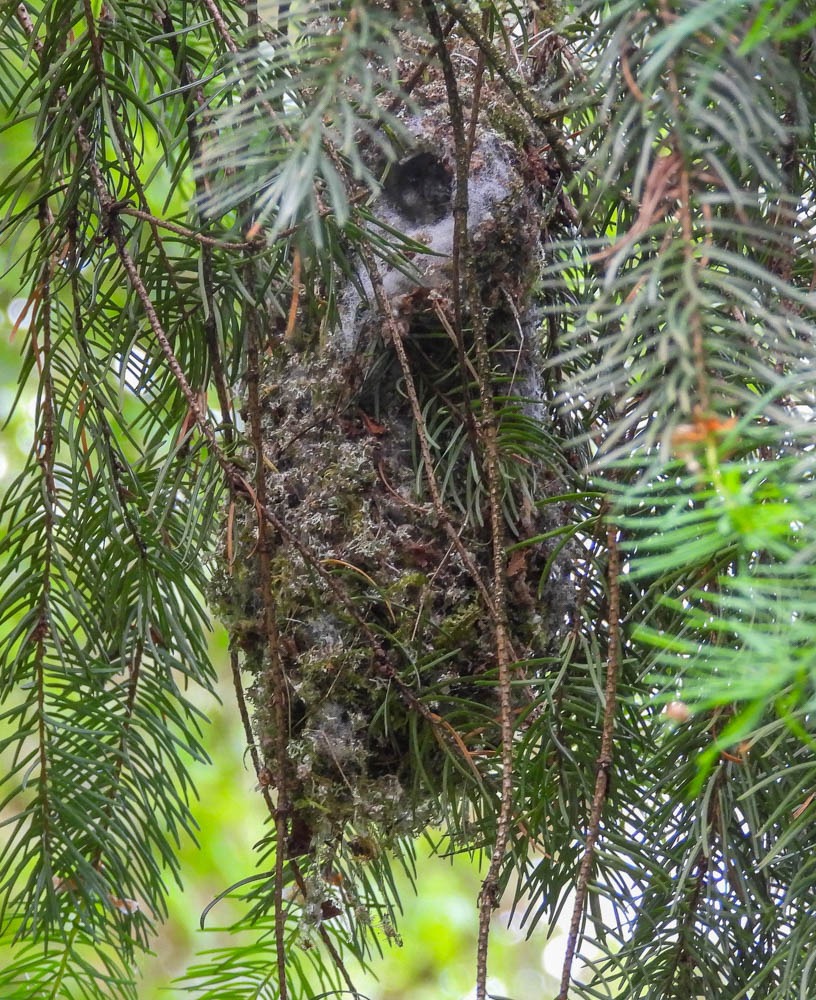
Several birds will sleep in the nest for warmth, their weight stretching it down to form an elastic “sock” up to a foot long. In Arizona, Dr. Sloane once found four adults and ten chicks occupying a single nest.
Both nest building and feeding of chicks may be done cooperatively. Dr. Sloane’s Arizona studies found that 37% of bushtit nests had an extra “helper”. These were often adult males. Only 9% of bird species practice cooperative breeding.
They are not picky about the location of their nest. In Oaks Bottom, we saw bushtit nests in Douglas-fir, Oregon white oak, ponderosa pine, Oregon ash, Himalayan blackberry, and old man’s beard clematis. Some of these nests were well hidden by drooping foliage, but others were not.
Usually four to six eggs are laid, one egg per day.
DNA results show that 10% of the nestlings are fathered by a male outside of the mated pair.
One polygamous male at Oaks Bottom was providing for two families (in different nests, of course).
Chicks are naked when they hatch. Their eyes open when they are eight days old. They take 18 days to fully fledge, at which time they are fed by the parents and helpers until they can forage for themselves.
Often, the mated pair will raise a second family the same year, sometimes constructing a new nest.
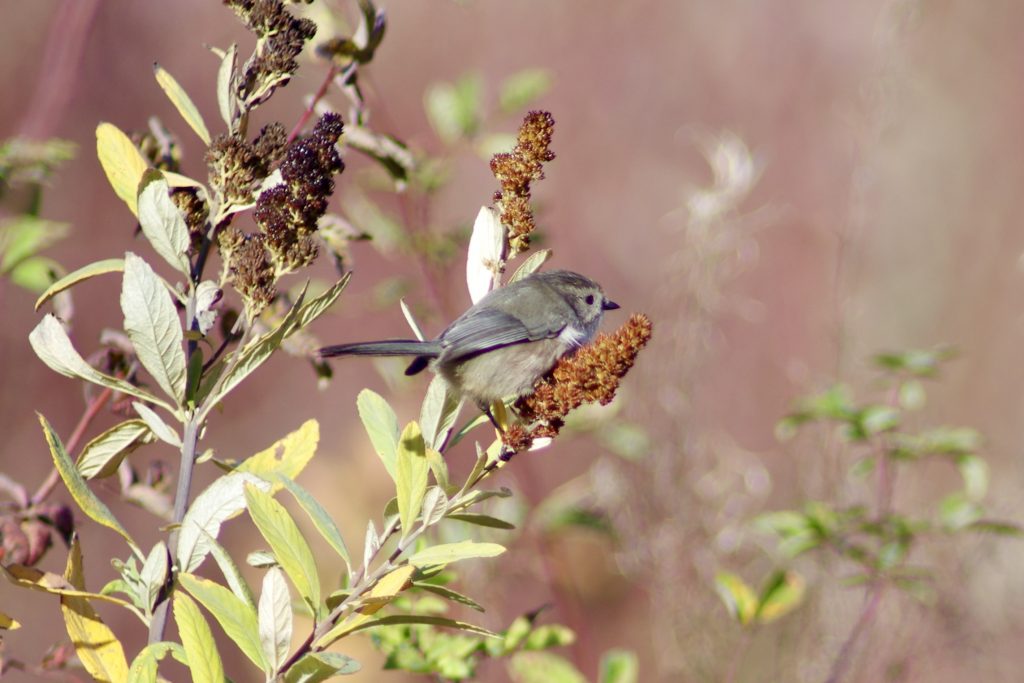
Nests are built in the same place every year. Interestingly, the new nest builders are sometimes different birds from those of the previous year.
Bushtits are very social. They know all the members of their flock, and they often visit each others’ nests. This may be how they remember the locations of nesting sites.
Fledged females disperse to other flocks, while males tend to remain in the same flock.
Female bushtits don’t live as long as males, often only as long as their first breeding year (second year after birth). Males at Oaks Bottom have lived up to six years.
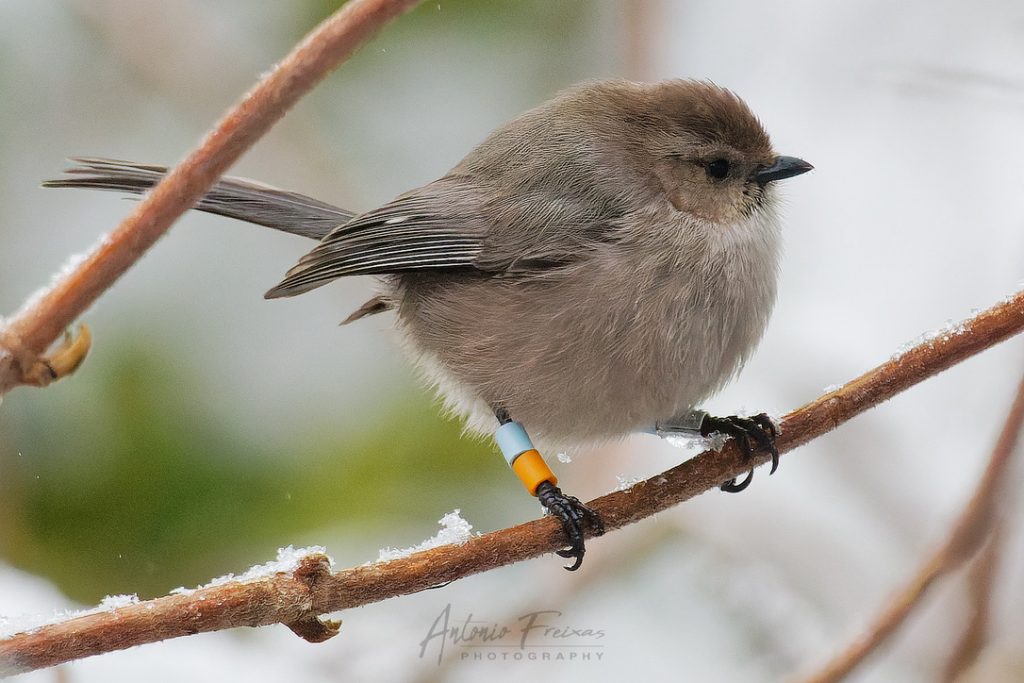
Sarah’s team at Oaks Bottom bands the bushtits in the study with up to four bands of different colors, creating a unique combination of colors for each. If you live in Sellwood-Eastmoreland and see a colorfully banded bushtit, you’ll know where it’s coming from!
Selected Publications
Sloane, S.A. The Bushtit Chronicles [unpublished manuscript].
Sloane, S.A. The Secret Lives of Bushtits (blog). Last updated August, 2023. https://bushtitsrule.blogspot.com/
Sloane, S.A., A. Gordon, and I.D. Connelly. 2022. Bushtit (Psaltriparus minimus) nestling mortality associated with unprecedented June 2021 heatwave in Portland, Oregon. Wilson Journal of Ornithology, 134(1): 155-162.
Sloane, S.A. 2020. Bushtit (Psaltriparus minimus), version 1.0. In Birds of the World (A. F. Poole and F. B. Gill, Editors). Cornell Lab of Ornithology, Ithaca, NY, USA.
Sloane, S.A. 1996. Incidence and origins of nest supernumeraries at Bushtit (Psaltriparus minimus) nests. Auk, 113(4): 757 – 770.